
In this article
- The Knee Is Strong—But It Depends on the Rest of Your Body
- Why Knee Pain Develops
- Common Knee Conditions
- Why Rest Alone Usually Doesn't Work
- The Importance of a Comprehensive Assessment
- Building Strength Without Fear
- The Psychological Side of Recovery
- Preventing Future Knee Problems
- Living Well With Osteoarthritis
- A Long-Term Investment in Your Mobility
There are few joints in the human body that endure as much stress as the knee. Every step you take, every flight of stairs you climb, every run through the park, every squat at the gym, and every jump during a game of basketball places force through this remarkable joint. Most of the time, the knee handles these demands effortlessly. But when pain develops, even the simplest daily activities can suddenly become frustrating and exhausting.
Many people assume knee pain is simply a sign of ageing or "wear and tear." Others believe that once the knee starts hurting, surgery is inevitable or that exercise should be avoided completely. These misconceptions often lead people to delay treatment, reduce their activity levels, and unintentionally allow the problem to worsen.
The good news is that most knee conditions can be managed successfully without surgery. Modern physiotherapy has transformed the way healthcare professionals understand knee pain. Rather than focusing solely on the painful joint, physiotherapists now examine the entire movement system—how the hips, ankles, feet, core, and even the spine work together to influence the way the knee functions.
At Apti Sports Physio & Beyond, we regularly help patients from Bolton, Caledon, Nobleton, Kleinburg, Brampton, Vaughan, and surrounding communities recover from knee injuries, improve mobility, and return to the activities they enjoy. Whether you're a competitive athlete, an active senior, or someone who simply wants to walk without discomfort, understanding why knee pain develops is the first step toward long-term recovery.
The Knee Is Strong—But It Depends on the Rest of Your Body
Although the knee is often described as a hinge joint, it is far more sophisticated than many people realize. It allows the body to bend, straighten, rotate slightly, absorb impact, and transfer force between the hips and the feet. To accomplish all of this, the knee relies on a complex partnership between bones, cartilage, ligaments, tendons, muscles, and the nervous system.
Unlike the hip, which is naturally stable because of its deep socket, the knee depends heavily on surrounding muscles for support. The quadriceps, hamstrings, gluteal muscles, calves, and core all work together to stabilize the joint during movement.
When one part of this system stops functioning efficiently, the knee often becomes the first place where symptoms appear.
For example, limited ankle mobility can change the way you squat or walk. Weak hip muscles may allow the knee to collapse inward during running or climbing stairs. Poor balance can increase stress on ligaments, while reduced core stability affects the body's ability to absorb force efficiently.
This explains why two people with similar knee pain may require completely different treatment plans. The pain may be in the same location, but the underlying cause can be entirely different.
Why Knee Pain Develops
Knee pain rarely appears overnight without reason. In many cases, it develops gradually as small movement problems accumulate over weeks, months, or even years.
One of the most common contributors is repetitive overload.
Runners, for example, may complete hundreds of thousands of steps each month. If running mechanics are slightly inefficient, the extra stress eventually begins affecting the knee. Similarly, construction workers repeatedly kneel, squat, and climb throughout the day, while office workers often spend prolonged periods sitting before suddenly asking their knees to perform demanding activities without adequate preparation.
Athletes place even greater demands on the joint.
Sports like soccer, hockey, basketball, volleyball, cricket, tennis, and skiing involve rapid acceleration, sudden stops, cutting movements, jumping, and pivoting. These movements generate enormous forces that the knee must safely absorb.
If muscles are weak, recovery is inadequate, or movement mechanics become inefficient, injuries become increasingly likely.
Common Knee Conditions
The knee can be affected by a wide range of conditions, each requiring a slightly different rehabilitation strategy.
Patellofemoral pain syndrome—often called "runner's knee"—is one of the most common causes of pain around the front of the knee. It frequently develops because the kneecap is not moving efficiently during activity, often influenced by hip weakness, muscle imbalance, or altered movement patterns.
Meniscus injuries affect the cartilage that cushions the knee joint. While these injuries sometimes occur during twisting movements in sports, they can also develop gradually through normal ageing.
Ligament injuries, including ACL and MCL tears, often occur during sudden changes of direction or awkward landings. These injuries may require lengthy rehabilitation, but physiotherapy remains essential whether surgery is performed or not.
Tendon problems, particularly patellar tendinopathy, commonly affect athletes who participate in jumping sports such as basketball and volleyball. Pain usually develops gradually rather than after one specific incident.
Osteoarthritis is another common source of knee discomfort, particularly among older adults. Contrary to popular belief, arthritis does not automatically mean the end of an active lifestyle. Research consistently shows that appropriate exercise remains one of the most effective ways to reduce pain, improve mobility, and maintain independence.
Why Rest Alone Usually Doesn't Work
Many people instinctively stop moving when their knee begins hurting.
While short periods of activity modification may be appropriate after an acute injury, prolonged rest often creates additional problems.
Muscles weaken surprisingly quickly.
Joint mobility decreases.
Balance deteriorates.
Confidence in movement declines.
Eventually, even simple activities feel more difficult than before.
Modern physiotherapy encourages appropriate movement rather than complete inactivity. Carefully selected exercises help maintain strength, improve circulation, reduce stiffness, and stimulate healthy tissue adaptation.
The goal is not to push through severe pain but to gradually rebuild the knee's ability to tolerate everyday activities.
The Importance of a Comprehensive Assessment
One of the greatest advantages of physiotherapy is that treatment begins with understanding the individual rather than simply naming the diagnosis.
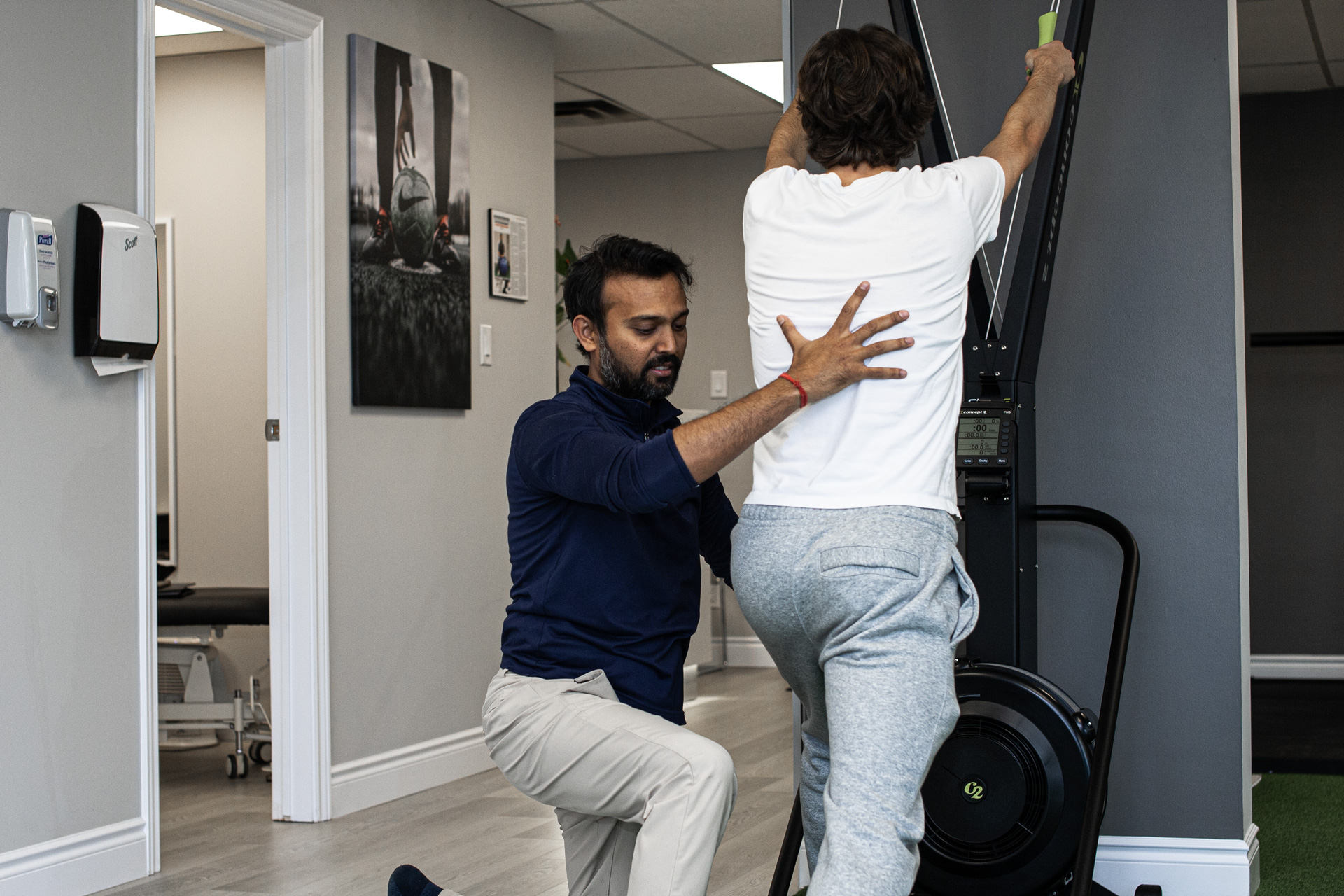
At Apti Sports Physio & Beyond, our assessment extends well beyond the knee itself.
We evaluate:
- Walking mechanics
- Squatting technique
- Hip strength
- Ankle mobility
- Balance
- Flexibility
- Core stability
- Sport-specific movement
- Occupational demands
- Previous injuries
This comprehensive approach frequently uncovers movement patterns that have contributed to the current problem.
For example, a patient experiencing recurring knee pain while running may actually have restricted ankle mobility and weak gluteal muscles. Another individual may demonstrate excellent strength but poor landing mechanics during jumping activities.
By identifying these factors early, rehabilitation becomes significantly more effective.
Building Strength Without Fear
One of the biggest concerns patients express is whether exercising will make their knee worse.
In most cases, appropriately prescribed exercise is one of the safest and most effective treatments available.
Strength training improves the ability of muscles to absorb force before it reaches the knee joint.
Balance training enhances joint stability.
Flexibility exercises restore efficient movement.
Functional exercises prepare patients for the specific demands of work, sport, or everyday life.
As confidence grows, rehabilitation gradually progresses toward more demanding activities.
For athletes, this may involve sprinting, jumping, agility drills, and sport-specific movements.
For older adults, the focus may shift toward climbing stairs comfortably, walking longer distances, or reducing the risk of falls.
The exercises differ, but the underlying principle remains the same: movement is medicine when prescribed correctly.
The Psychological Side of Recovery
Physical healing is only one aspect of rehabilitation.
Many individuals become anxious after a significant knee injury.
They worry about returning to sport.
They fear climbing stairs.
They hesitate before running again.
Some avoid activities they once loved because they no longer trust their knee.
Physiotherapy addresses these concerns by progressively rebuilding confidence alongside physical capacity.
Each successful movement reinforces the brain's confidence in the joint.
Over time, patients often discover that they are capable of much more than they initially believed.
Preventing Future Knee Problems
The best rehabilitation program is the one you never need.
Preventing knee pain begins long before symptoms appear.
Maintaining strong hips and legs, improving flexibility, wearing appropriate footwear, increasing training loads gradually, warming up properly before exercise, and addressing minor discomfort early all contribute to healthier knees.
Regular movement screening is particularly valuable for athletes.
Small movement inefficiencies identified today may prevent much larger injuries tomorrow.
Similarly, individuals with physically demanding occupations benefit from learning safer lifting, kneeling, and movement strategies that reduce unnecessary stress on the knees.
Living Well With Osteoarthritis
Many people believe arthritis automatically leads to disability.
Current research tells a very different story.
Although cartilage changes cannot always be reversed, pain, strength, mobility, and overall function often improve dramatically through structured physiotherapy. Exercise helps nourish cartilage, strengthen supporting muscles, improve balance, and reduce stiffness.
Combined with education and healthy lifestyle habits, physiotherapy enables many individuals with arthritis to remain active for years while delaying or even avoiding joint replacement surgery.
A Long-Term Investment in Your Mobility
Healthy knees allow us to remain independent, active, and engaged in the activities that give life meaning.
Whether that means chasing children around the backyard, hiking with friends, playing recreational hockey, training for a marathon, or simply walking comfortably through the neighbourhood, protecting knee health is an investment in future quality of life.
Pain should never be viewed as something that simply comes with age.
It is often the body's way of asking us to pay attention to movement, strength, and recovery.
With the right assessment, individualized rehabilitation plan, and evidence-based treatment, many knee problems improve significantly without invasive procedures.
At Apti Sports Physio & Beyond, we believe every patient deserves more than temporary symptom relief. Our approach focuses on identifying the true cause of knee pain, restoring efficient movement, improving strength, and helping patients throughout Bolton, Caledon, Brampton, Nobleton, Kleinburg, Vaughan, and surrounding communities return to the activities they enjoy with confidence.
Your knees carry you through thousands of steps every day.
Taking care of them today is one of the best investments you can make in your health tomorrow.